 Português
 English
 Deutsch
 Español
 Français
 Italiano
The festas are the part of King where points are won, and the auction is what makes them interesting. The dealer has the right to choose the contract, but the others can buy that right. Played well, the auction turns a weak hand into points; played badly, it hands the festa to an opponent.
This article explains the auction step by step and walks through four situations with the numbers worked out. The reference rules are on the King page.
Who the beneficiary is
In each of the four festas, the dealer is the beneficiary. If nobody buys the festa, they choose the contract: trumps in a suit of their choice, no trumps or nulls. With trumps or no trumps, every trick is worth 25 points to whoever takes it. In nulls, every trick taken costs points.
The beneficiary’s problem is simple: the cards they were dealt may not suit any contract. That is where the auction helps.
How bids are made
The auction starts with the player after the dealer. Each player, in turn, bids tricks or passes.
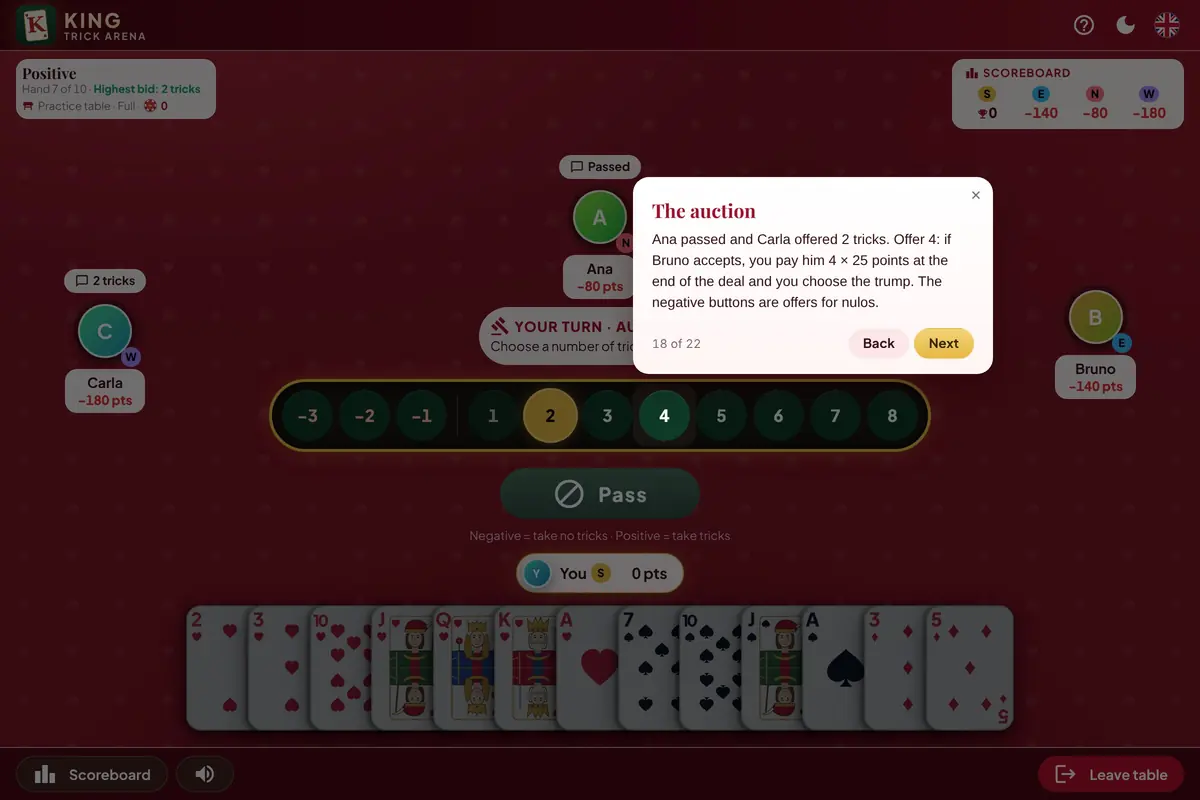 The auction for a festa, where Carla has offered 2 tricks. Screenshot from the King tutorial.
- Bids for positives: 1 to 8 tricks, at 25 points each. The bidder is saying "let me play and I will pay you these tricks".
- Bids for nulls: −1, −2 and −3, worth 3, 6 and 8 tricks (75, 150 and 200 points). The bidder wants to play nulls.
Each bid must be higher than the best bid so far. There is one exception: a player who speaks before the one who made the best bid may match it instead of beating it. This gives a small advantage to whoever sits closer to the beneficiary.
When everyone passes or no higher bid is possible, the auction closes and the beneficiary decides.
The beneficiary’s four answers
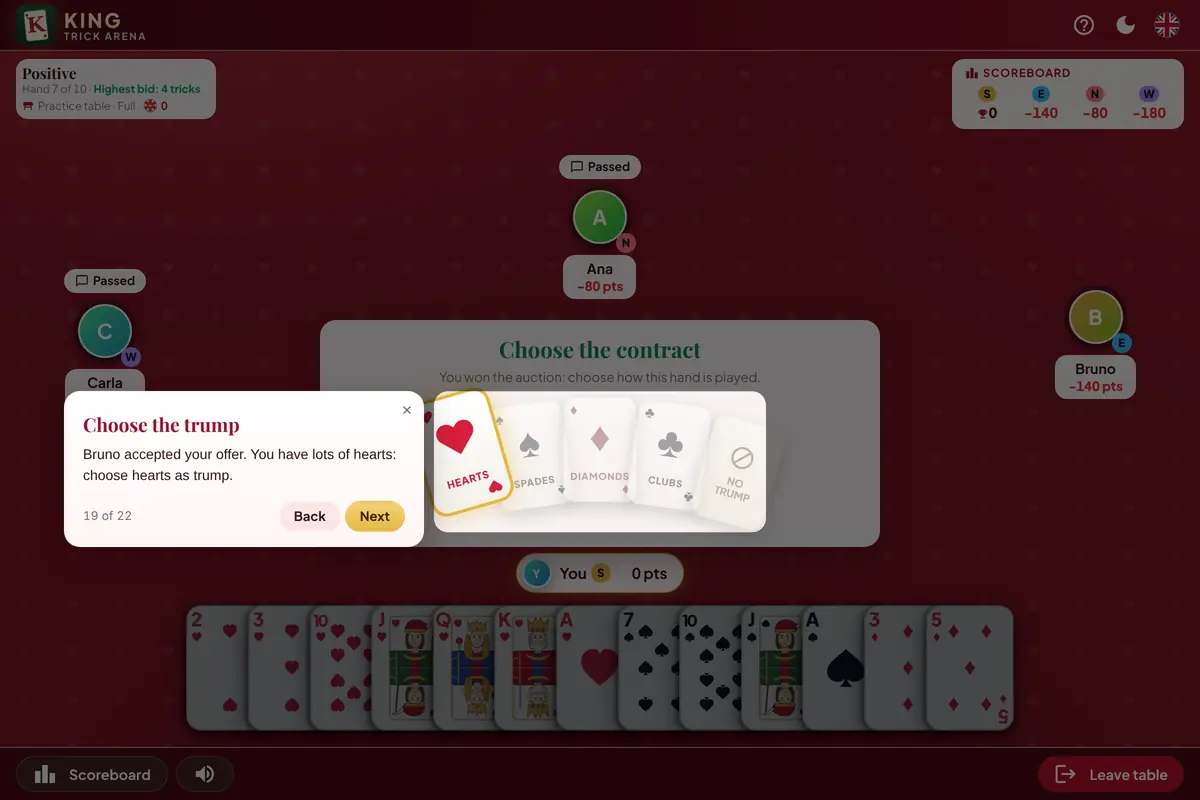 You won the auction and choose how the hand is played: with a trump suit or no trumps. Screenshot from the King tutorial.
Accept
The best bidder plays the hand and, at the end, pays the beneficiary the points bid. With a bid for positives they choose trumps or no trumps; with a bid for nulls they play nulls.
Accepting is good when the bid is worth more than what the beneficiary would make by playing. They receive the points without risk and can still take tricks during the hand, like any other player.
Reject
The bidder can raise the bid, and the beneficiary decides again, or pass. If they pass, or if the bid was already −3, nobody pays anything: the beneficiary chooses the contract and plays.
Rejecting is a way of saying "that is too little". It works when the beneficiary has a reasonable hand and thinks the bidder is offering less than the festa is worth.
8 or nulls
This is an ultimatum. The bidder must choose: either pay 8 tricks (200 points) and choose trumps or no trumps, or refuse and the hand is played as nulls, with nobody paying. Letting the time run out counts as a refusal.
The ultimatum puts the bidder between a rock and a hard place. If they have a very strong hand, they may pay the 200. If not, the hand goes to nulls, where their high cards become a burden. For the beneficiary, "8 or nulls" is good when they hold low cards and are not afraid of nulls.
Points
Nobody plays: the beneficiary gets 100 points and each opponent 75. It is only possible with no bids, with a bid of 1 to 3 tricks or with −1 (also after it was rejected).
Points is the safe way out for someone with a bad hand and low bids. They score 100 and give 75 to each of the others: the opponents move up a little, but nobody runs away with the game.
A bid of 8 tricks must always be accepted.
Example 1: selling a weak hand well
Ana deals. Her cards are spread out, no suit has more than four cards and she holds only one ace. Bruno bids 3, Carla bids 5, Diogo passes.
Ana does the maths. Playing with trumps in her best suit, she might take 3 or 4 tricks with luck: 75 to 100 points. Carla’s bid gives her 125 guaranteed points, and she can still take a trick or two during the hand. She accepts.
Carla chooses hearts, where she has six cards with the ace, king and queen, and takes 7 tricks: she scores 175 and pays Ana 125, keeping +50. Ana takes 2 tricks during the hand (+50) and ends this festa with 175, more than her own cards would have given her.
Example 2: rejecting a short bid
Bruno deals and has a strong hand: five spades with the ace, king and jack and two aces in other suits. Carla bids 2 tricks. Nobody else bids.
With spades as trumps, Bruno expects 6 or 7 tricks, that is 150 to 175 points. The 50 points of Carla’s bid are far too little. He rejects. Carla has an average hand and passes. Bruno chooses spades, plays, and takes 7 tricks.
The lesson: rejecting costs nothing when your hand is worth more than the bid.
Example 3: the ultimatum that works
Carla deals. Her hand is full of low cards, with no picture cards in hearts or clubs. Diogo, who holds plenty of possible trumps in diamonds, bids 4 tricks.
Accepting would give Carla 100 points. But she knows her hand is excellent for nulls. She presses 8 or nulls. Diogo has two options:
- pay 200 points and play with diamonds: he would need more than 8 tricks just to break even;
- refuse, and play nulls with his high cards.
Diogo refuses. The hand is played as nulls, where each player gets 325 points minus 75 for every trick they take. Carla takes no tricks and scores +325. Diogo, with aces and kings he cannot get rid of, takes 6 tricks and scores 325 − 450 = −125. Carla gained far more than the 100 points she was offered, and the bidder was punished.
The risk: had Diogo held an extraordinary hand, he would have paid the 200 and played. That is not bad for Carla either, since she receives the most the auction allows.
Example 4: when Points is the best answer
Diogo deals. The hand is bad for everything: some high cards that spoil nulls, but no suit for trumps. Only Bruno bids, 2 tricks.
- Accept: 50 points for Diogo, and Bruno plays with the advantage.
- Play himself: with luck, 2 or 3 tricks.
- Points: 100 for Diogo and 75 for each opponent.
Points gives him twice the bid and does not hand the hand to Bruno. It is the right choice.
Common auction mistakes
- Bidding for the hand you wish you had. Count the tricks you have, not the ones you hope for. A long suit without the ace or king can be worth much less than it looks.
- Forgetting that the buyer pays. Buying at 6 tricks and taking 6 is a draw: you paid 150 and scored 150. Buying is only worth it when you expect to take more than you pay.
- Always accepting. Accepting is comfortable, but a well-placed rejection or "8 or nulls" can be worth twice as much.
- Ignoring the score. In the last festa, a player in the lead may prefer Points and play it safe; a player behind needs to take risks.
To practise
The best way to learn the auction is to play and review the numbers at the end of each festa: what was bid, what you decided and how many points it gave. On TrickArena, the hand summary shows each player’s points, so you can compare with what you would have made playing yourself.
For more ideas, read the ten King strategy tips, and for the full rules the King page.