 Português
 English
 Deutsch
 Español
 Français
 Italiano
Sueca is the most played trick-taking card game in Portugal. Four people play in two teams: your partner sits opposite you. It uses a 40-card deck, without the 8s, 9s and 10s. It is played in cafés, clubs and at family tables, and it is often the first "serious" card game people learn.
On TrickArena you play Sueca online, in real time, with other people. Chips are virtual and have no money value.
This page has the full rules, exactly as they are played on TrickArena. For a lighter first read, start with the beginner’s guide.
In short
- 4 players in 2 teams, partners sitting opposite each other. A 40-card deck.
- Each player gets 10 cards and 10 tricks are played. A trick is one round in which each player plays one card.
- The last card dealt is turned face up: its suit is the trump for the hand.
- Each team adds up the points of the cards in the tricks it takes. There are 120 points in each hand, and the team that takes more than 60 wins the hand.
- A match is played to 1, 3 or 5 games. The first team to reach that number wins.
The cards
Take the 8s, 9s and 10s out of a standard deck and 40 cards remain, 10 of each suit. The order is different from other games: the seven, the bisca, ranks above the king.
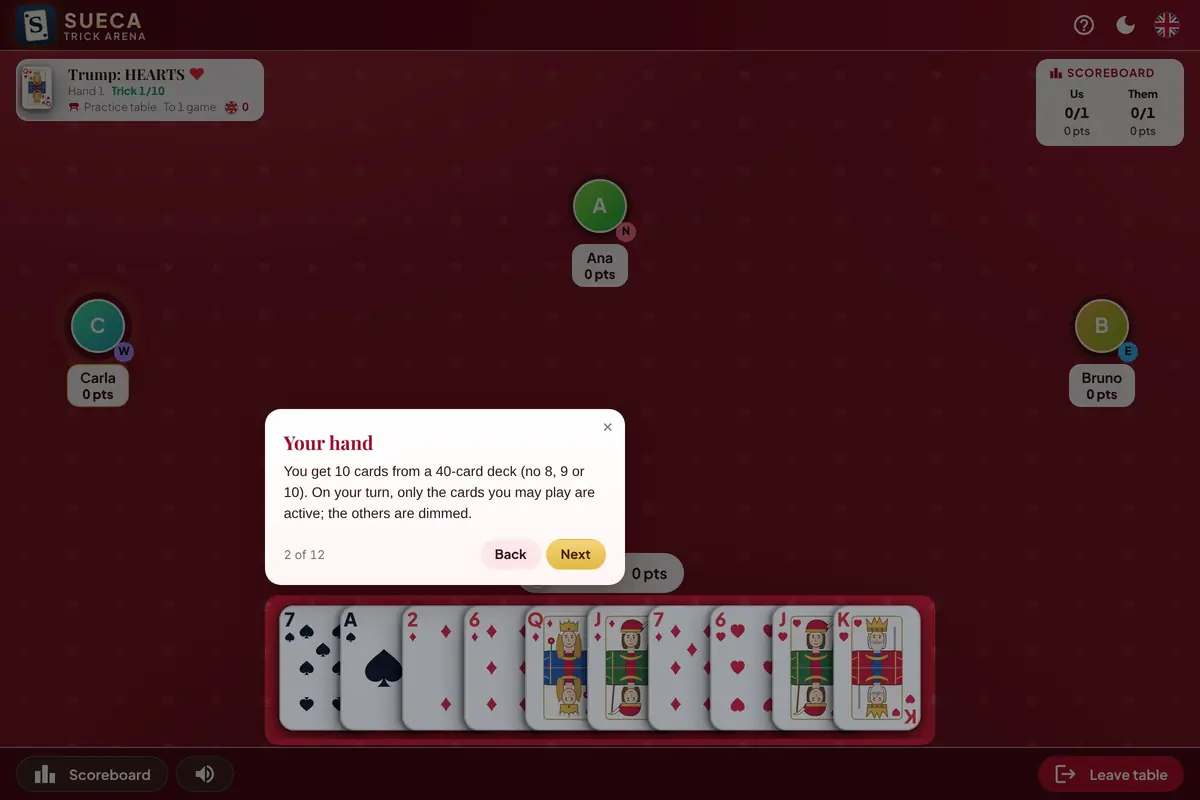 Your 10 cards at the bottom, with Ana, your partner, opposite you. Screenshot from the Sueca tutorial.
| Card | Rank | Points |
|---|---|---|
| Ace | 1st (highest) | 11 |
| Seven (bisca) | 2nd | 10 |
| King | 3rd | 4 |
| Jack | 4th | 3 |
| Queen | 5th | 2 |
| 6, 5, 4, 3, 2 | 6th to 10th | 0 |
Each suit holds 30 points and the whole deck 120. Note that the jack ranks above the queen, unlike many other games, and that half the cards are worth nothing: the points are concentrated in aces and sevens.
The trump
The dealer deals the cards one at a time, starting with the next player. The last card, which goes to the dealer, is turned face up: its suit is the trump for the hand. That card stays in view of everyone until the dealer plays it, so the whole table knows the dealer holds at least that trump.
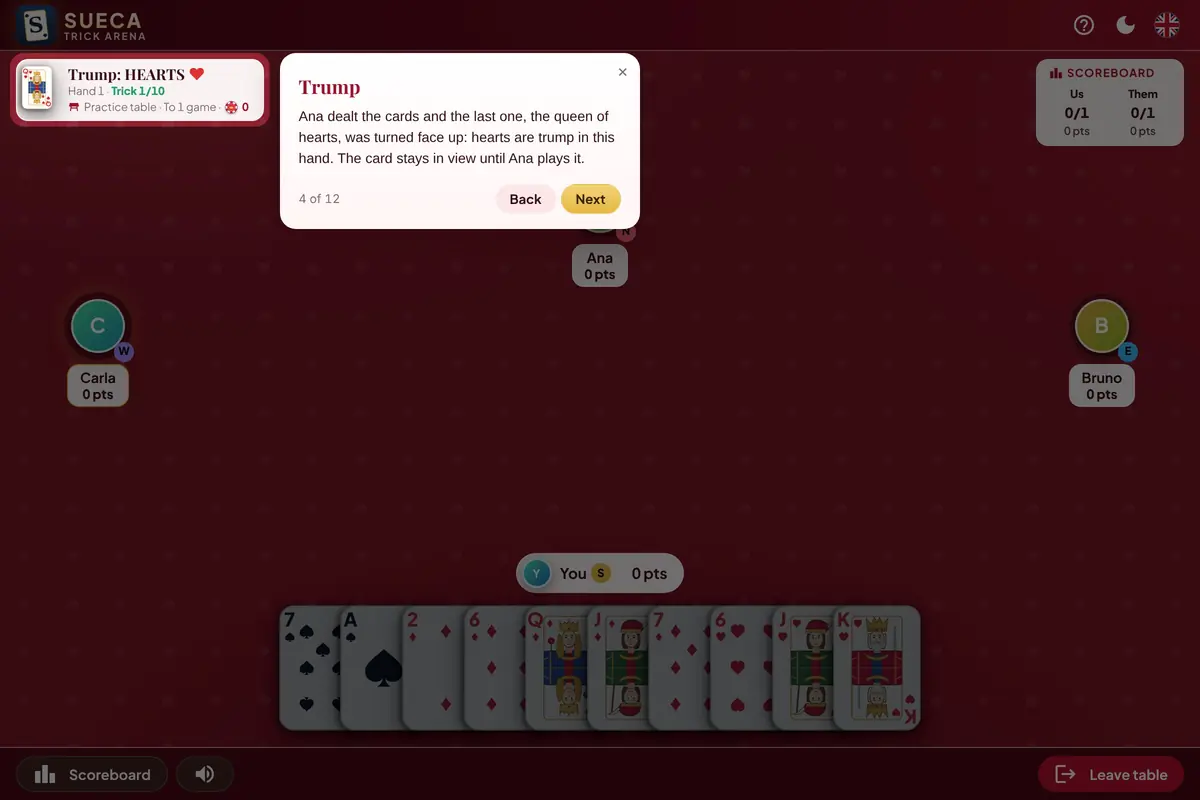 Ana dealt, and the turned-up card, the queen of hearts, makes hearts trumps. Screenshot from the Sueca tutorial.
Each hand is dealt by the player after the previous dealer, so the trump changes from hand to hand.
How each trick is played
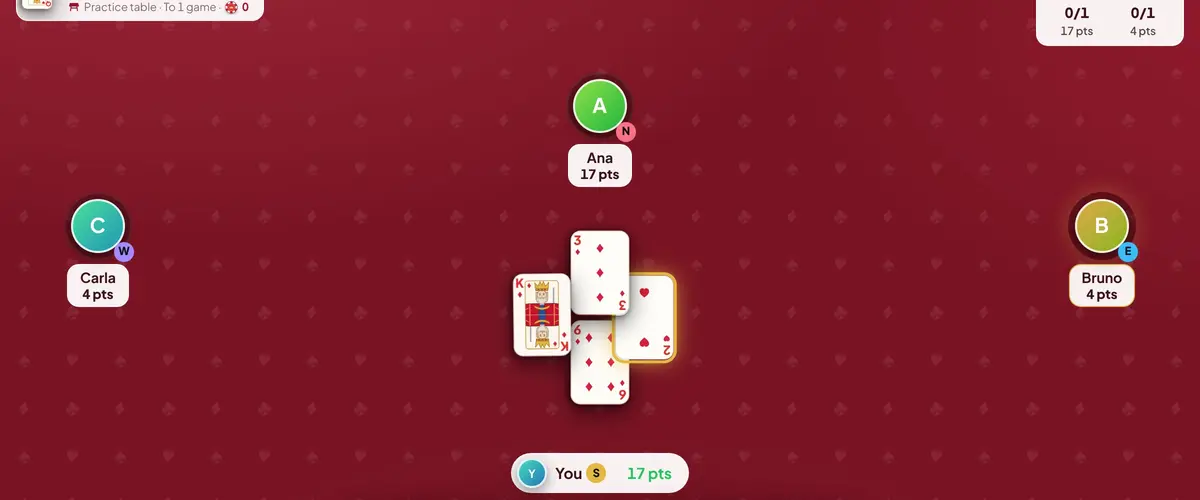 Bruno has no diamonds and ruffs with the 2 of hearts, the trump suit, beating the king of diamonds. Screenshot from the Sueca tutorial.
- The player after the dealer leads the first trick. After that, whoever won the previous trick leads.
- You must follow suit: play the suit led if you have it.
- Without the suit led, you may play any card. You may trump, but you do not have to: you can also discard a card of another suit.
- The highest trump wins the trick. If nobody played a trump, the highest card of the suit led wins.
Example. Hearts are trumps. Joana leads the king of clubs. Luís, an opponent, follows with the 3 of clubs. Pedro, Joana’s partner, has no clubs and discards the seven of diamonds to give his team points. Marta, last to play, has no clubs either and trumps with the 2 of hearts. Marta wins the trick: a small trump beats any card of another suit. Marta and Luís’s team takes 4 + 0 + 10 + 0 = 14 points.
The example shows why Sueca is a team game: Pedro discarded 10 points thinking the trick was his partner’s, and lost them. Knowing who can still trump is half the game.
The games of each hand
At the end of the hand, each team counts the points of the cards it won. The team that goes over 60 wins the hand, and the number of games it scores depends on how far it went:
| Team points | Games |
|---|---|
| 61 to 90 | 1 |
| 91 to 119 | 2 |
| 120 (every trick) | 4 |
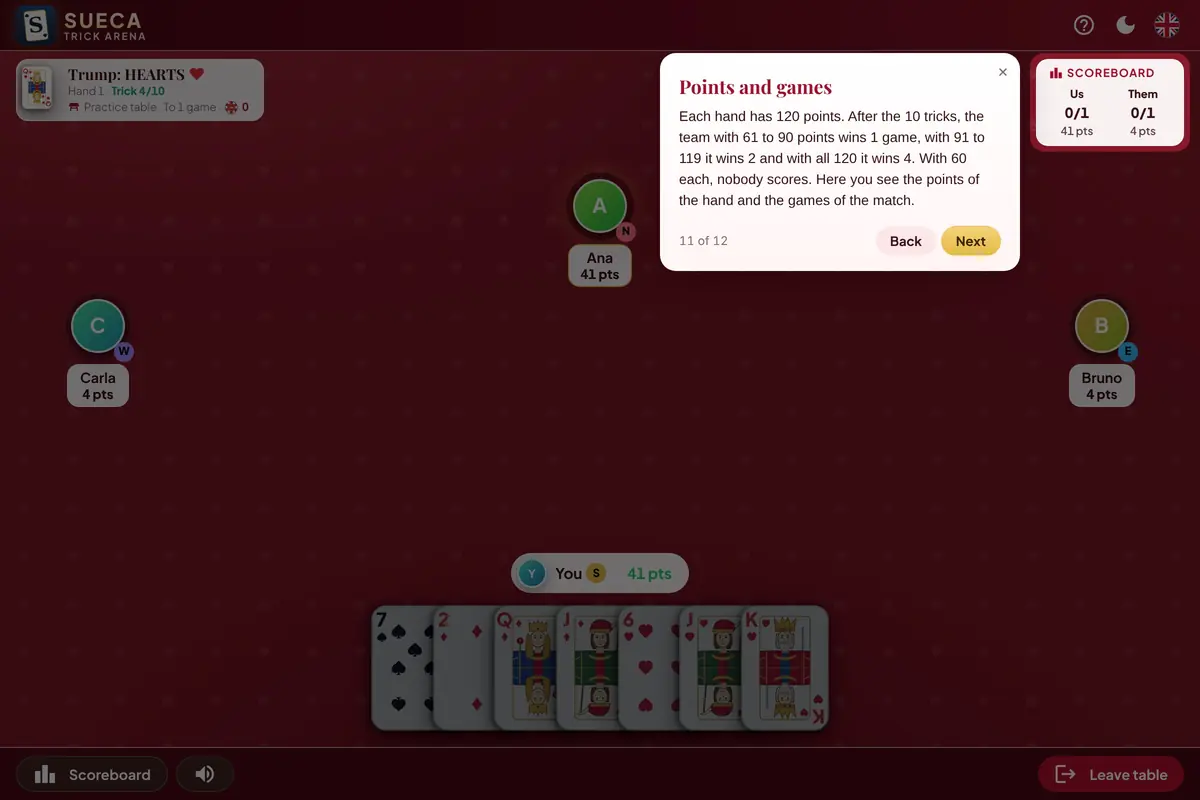 Each hand has 120 points; the team with 61 to 90 wins 1 game, with 91 to 119 wins 2, and with all 120 wins 4. Screenshot from the Sueca tutorial.
With 60 points each the hand is a tie and nobody scores games. At Portuguese tables a hand of 91 points or more is often called a capote, and a hand with every trick a bandeira.
The match
When the table is created you choose whether the match is to 1, 3 or 5 games. The first team to reach that number wins. Since a hand can be worth 2 or 4 games, a match to 5 can end in two hands, or last ten.
Seats and partners
You choose your seat when you join the table and, while the table is not full, you can move to another free seat. Your partner is the player opposite you. To play with a friend, sit in opposite seats.
Time, lives and leaving
- Each move has a time limit, chosen when the table is created. If time runs out, the game plays a valid card for you and you lose a life.
- Each player has 3 lives. A player who runs out of lives or leaves ends the match: they lose their entry, and the other three, partner included, get theirs back.
Chips and ranking
- The entry in chips is paid when all four confirm. At the end, 90% of the entries go to the winning team, half to each player; 10% go to the house.
- Chips are virtual, cannot be bought and cannot be exchanged for money.
- Ranking: each player of the winning team gains 3 points, each player of the losing team loses 1. A player who leaves or runs out of lives loses 3.
- There are six levels, starting at 0, 20, 60, 150, 300 and 600 ranking points. Some tables only accept certain levels.
Frequently asked questions
Do I have to trump if I cannot follow suit? No. In Sueca you only have to follow suit. Without the suit led you may trump or discard, as you see fit.
What about reneging? At the table, playing another suit while holding the suit led is called a renege (renúncia) and is usually penalised. On TrickArena it cannot happen: the game only lets you play valid cards.
Can the dealer play the turned-up card whenever they like? Yes. It is a card in their hand like any other; it just stays visible until it is played.
Why does the seven rank above the king? It is the tradition of the bisca family, which Sueca comes from. The story is in the article Where Sueca comes from.
Can I agree on signals with my partner? No: agreed signals are cheating, at the table and online. What you can "tell" your partner is through the cards you play and discard, as the Sueca strategy article explains.