 Português
 English
 Deutsch
 Español
 Français
 Italiano
Vazadas is a trick prediction card game for 3 to 5 players, each playing for themselves. In each hand every player says how many tricks they will take, and anyone who misses loses a life. The winner is not who takes the most tricks, but who gets it right: taking too many costs as much as taking too few. The last player with lives left wins.
On TrickArena you play Vazadas online, in real time, with other people. Chips are virtual and have no money value.
This page has the full rules, exactly as they are played on TrickArena. For a lighter first read, start with the beginner’s guide; the app also has a step-by-step tutorial in the Help menu.
In short
- 3 to 5 players, each for themselves, with a 40-card deck (no 8s, 9s or 10s).
- The number of cards changes from hand to hand: 1 in the first, 2 in the second, and so on up to the maximum.
- Before playing, each player predicts how many tricks they will take. Anyone who misses, by one trick or by several, loses a life.
- You do not have to follow suit: the highest-ranked card wins, and the ace of hearts always wins.
- A player with no lives left is out. The last one with lives wins.
The cards
The game uses a 40-card deck, without the 8s, 9s and 10s. The order, highest to lowest, is the same as in Sueca:
ace, seven, king, jack, queen, 6, 5, 4, 3, 2.
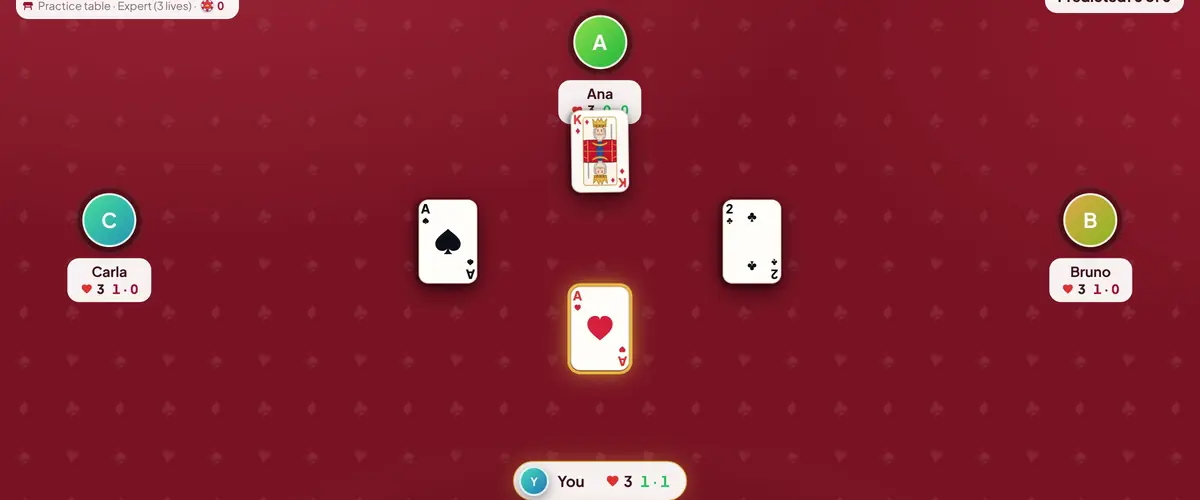 Your ace of hearts wins the trick, even against Carla’s ace of spades. Screenshot from the Vazadas tutorial.
In Vazadas suits do not matter at all, with one exception: the ace of hearts is the strongest card in the deck and always wins, even against the other three aces.
Cards in each hand
In the first hand each player gets 1 card, in the second 2, and so on up to the maximum. Then it goes back to 1 and the cycle repeats. The cards are shuffled every hand, and the cards left over stay out, unseen by anyone.
| Players | Maximum cards | Cards left out in the largest hand |
|---|---|---|
| 5 | 8 | 0 |
| 4 | 10 | 0 |
| 3 | 13 | 1 |
| 2 | 20 | 0 |
When someone is knocked out, the maximum becomes that of the remaining players. The cycle continues and only goes back to 1 when the next hand would go over the new maximum.
The cards left out make small hands very unpredictable. With 4 players and 2 cards each, 32 cards are unseen: the ace of hearts may not even be in play.
Predictions
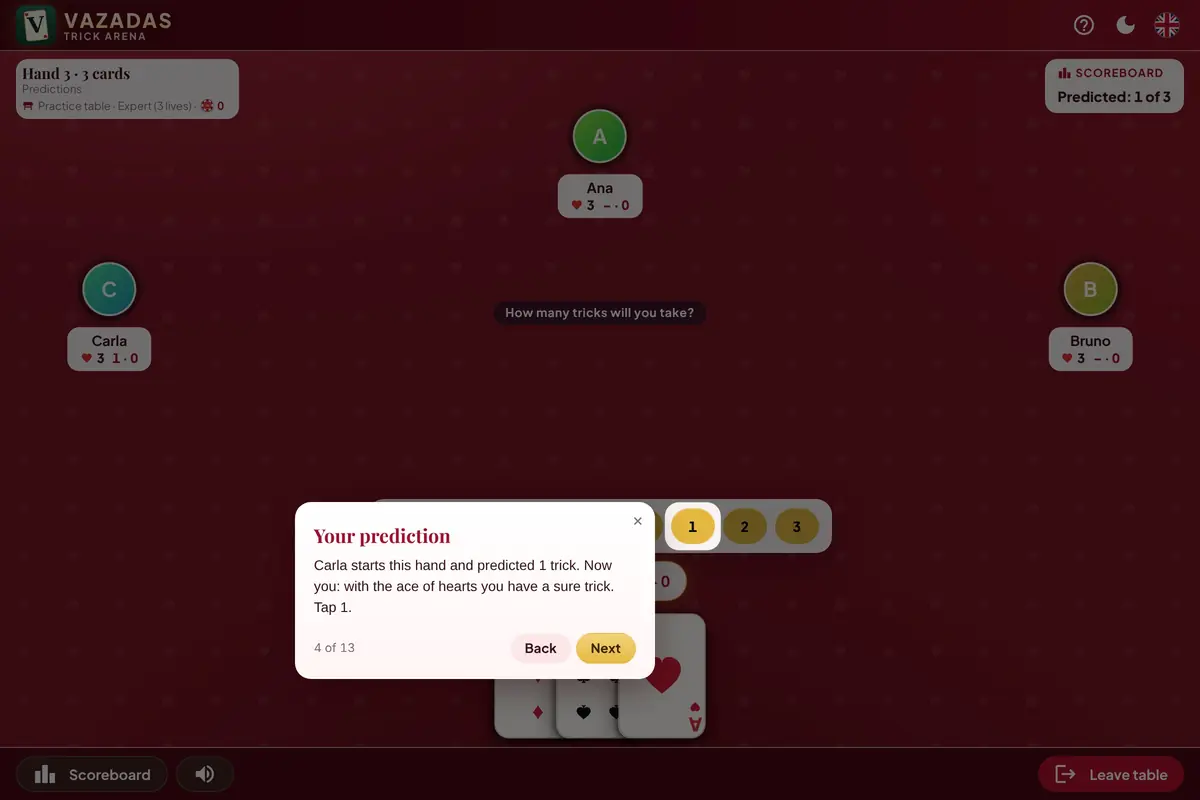 You choose how many tricks you will take in this hand. Screenshot from the Vazadas tutorial.
- In the first hand, the starting player is drawn at random. In each following hand the player to the right of the previous starter begins.
- Starting with that player and in table order, each one says how many tricks they will take, from 0 up to the number of cards they hold.
- Predictions stay visible to everyone during the hand.
- The predictions can add up to any number, including the number of cards. Unlike other prediction games, the last player to speak has no restriction.
How each trick is played
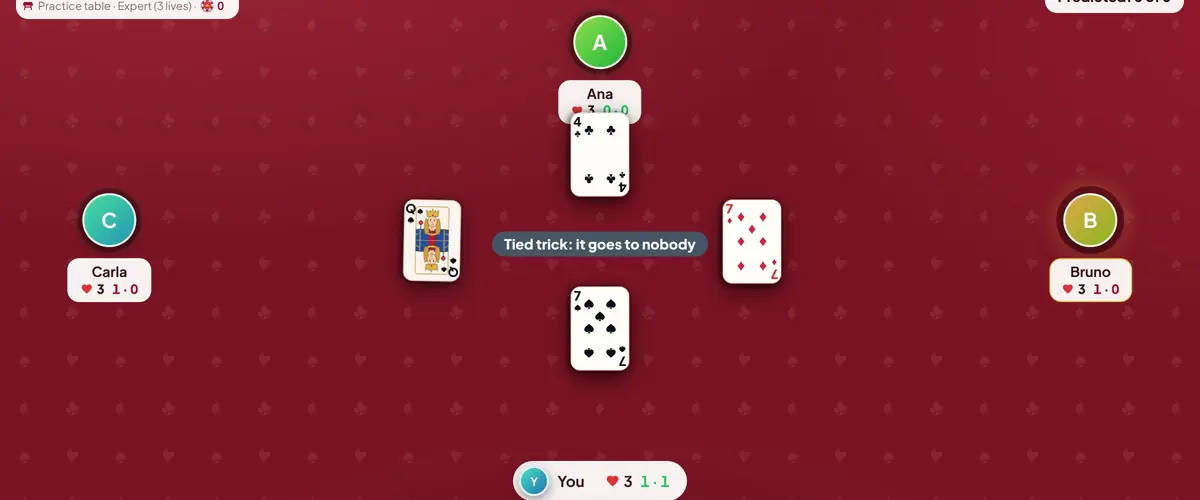 Bruno’s 7 and your 7 tie as the highest cards: the trick goes to nobody. Screenshot from the Vazadas tutorial.
- The player who started the hand leads the first trick; after that, whoever won the previous trick leads.
- You do not have to follow suit: you may play any card in your hand. Suits do not count, only the rank of the card.
- The highest-ranked card wins. The ace of hearts always wins.
- Ties: if two or more cards tie for the highest rank, the trick goes to nobody. The next trick starts with the last player who played one of those cards.
- When the table is created you choose whether each player’s tricks are visible during the hand or only in the hand summary.
Tie example. At a table of 4, Rui plays the king of clubs, Sara the 5 of diamonds, Tomé the king of spades and Vera the queen of hearts. The two kings tie for the highest rank and the trick goes to nobody. The next trick starts with Tomé, the last to play a king. A trick that does not count can save someone who predicted zero, or ruin the count of someone who needed it.
Lives and elimination
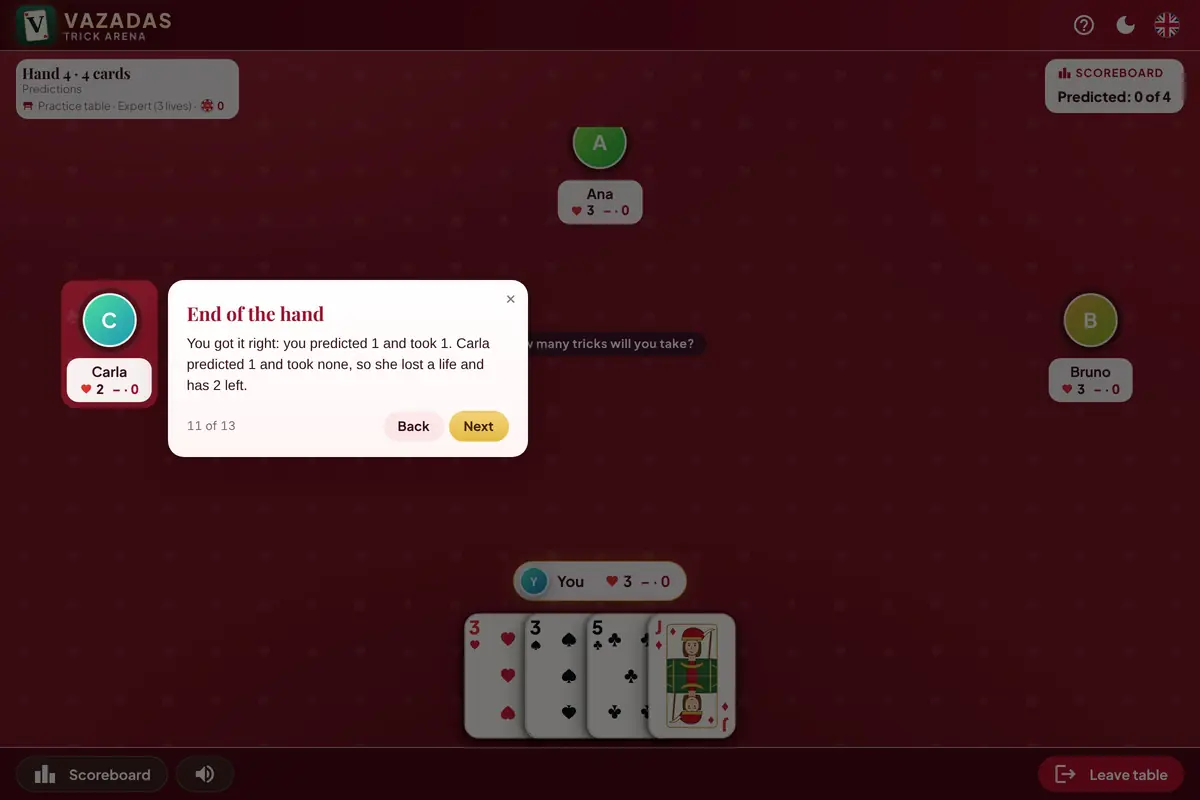 At the end of the hand, Carla predicted 1 trick, took none and loses a life. Screenshot from the Vazadas tutorial.
- At the end of the hand, players who took exactly the tricks they predicted keep their lives. Anyone who took more or fewer loses one life, whatever the difference.
- A player with no lives left is eliminated. Players eliminated in the same hand share the same place.
- If everyone left is on their last life and they all miss in the same hand, nobody loses the life and the next hand is played. The game always has a winner.
Game modes
| Mode | Lives | For whom |
|---|---|---|
| Ultra fast | 1 | Short games: one mistake and you are out |
| Expert | 3 | Players who already know the game |
| Intermediate | 5 | A good balance between luck and skill |
| Beginner | 10 | To learn without going out early |
When the table is created you also choose the number of seats (3 to 5), the time per move and whether the tricks taken are visible during the hand.
Time and leaving
- Each prediction and each move has the time chosen when the table is created (20, 30 or 40 seconds). If it runs out, the game predicts 0 or plays your lowest card for you. You do not lose a life for that, but an automatic prediction of 0 can cost you the life at the end of the hand.
- 3 time-outs in a row count as leaving.
- A player who leaves mid-game is out, loses their entry and finishes last. The game continues for the others until one player is left.
Chips and ranking
- The entry in chips is paid when everyone confirms. The house keeps 10% of the entries and the rest is the prize.
| Players | Prize |
|---|---|
| 3 or 4 | 1st place takes it all |
| 5 | 1st place 70%, 2nd place 30% |
- Players tied for a place share that place’s prize.
- Chips are virtual, cannot be bought and cannot be exchanged for money.
- Ranking: +3 for prize winners, −1 for the others and −3 for anyone who leaves.
- There are six levels, starting at 0, 20, 60, 150, 300 and 600 ranking points. Some tables only accept certain levels.
Frequently asked questions
Does taking too many tricks also cost a life? Yes. If you predicted 1 and took 2, you lose a life, just as if you had taken 0.
Does the ace of hearts always win, even against another ace? Yes. It is the only card that can neither tie nor lose.
Can I predict 0 with the ace of hearts in my hand? You can, but you will miss: you have to play every card by the end of the hand, and the ace of hearts always wins the trick it is played in. With it, always count at least one trick.
What do I do in a one-card hand? With a single card, the prediction is 0 or 1. A high card at a table of 5 is much less safe than the same card at a table of 3, because with more players there are more cards in play. The article How to get your prediction right in Vazadas has examples.
Why don’t I have to follow suit? It is one of the hallmarks of Vazadas: since suits do not count, each card is worth only its rank, and predicting depends on counting high cards, not long suits.