 Português
 English
 Deutsch
 Español
 Français
 Italiano
King is a trick-taking card game for four players, played in many countries. Everyone plays for themselves, with a standard 52-card deck. A game has two parts: first the negative hands, where everyone tries to avoid penalties, and then the positive hands, the festas, where players fight for tricks.
On TrickArena you play King online, in real time, with other people. There are no bots: the four seats at the table are always taken by players. Chips are virtual and have no money value.

This page has the full rules, exactly as they are played on TrickArena. If you have never heard of King, start with the beginner’s guide and come back here when you have questions.
In short
- In each hand every player gets 13 cards and 13 tricks are played. A trick is one round in which each player plays one card.
- First come six negative hands, each with its own penalty. Then come four festas, where tricks score points (or, in nulls, cost them).
- The player with the most points after all hands wins.
Cards and tricks
The game uses a 52-card deck without jokers. Card order, lowest to highest, is 2, 3, 4, 5, 6, 7, 8, 9, 10, jack, queen, king, ace. Suits have no order between them.
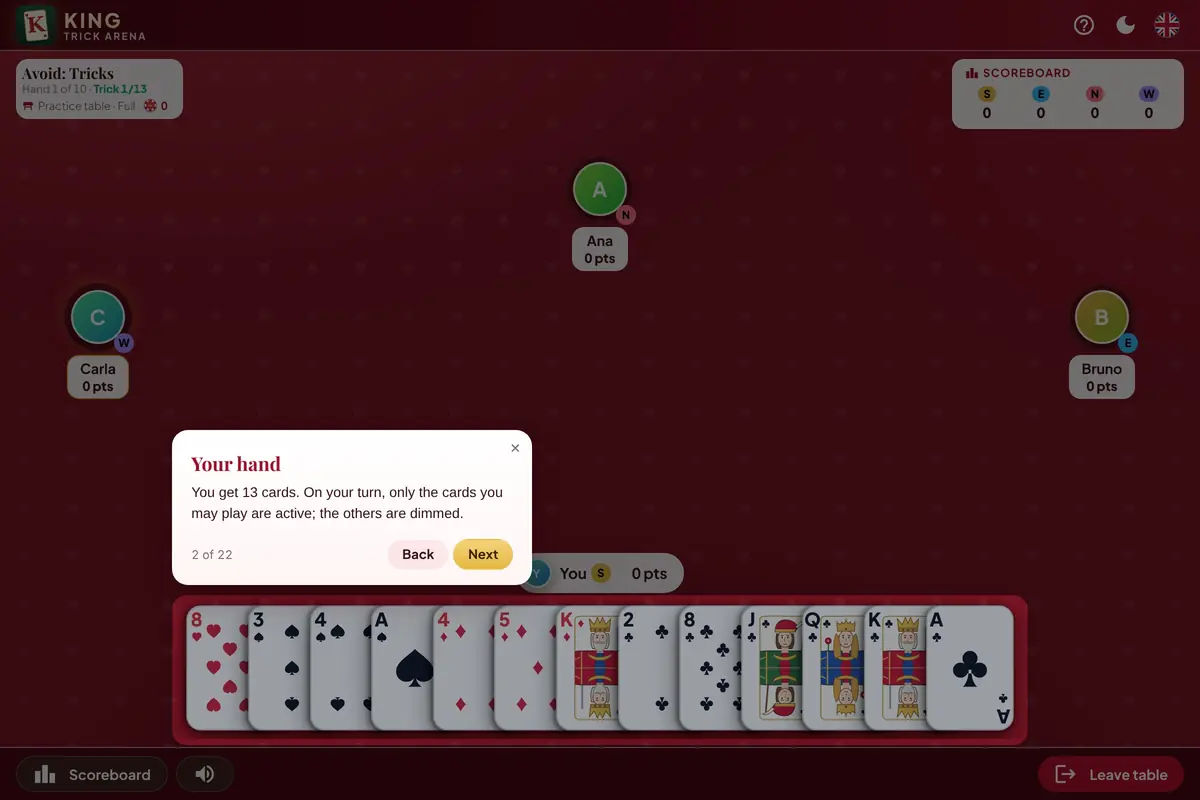 Your 13-card hand at the bottom, with Ana, Bruno and Carla around the table. Screenshot from the King tutorial.
The dealer leads the first trick of each hand; after that, whoever won the previous trick leads. The first card played sets the suit led, and the other players must follow suit: play a card of that suit if they have one. A player without that suit may play any card.
The highest card of the suit led wins the trick. A card of another suit never wins, however high, unless it is a trump in a festa played with trumps.
Example. Rui leads the 9 of spades. Sara plays the king of spades, Tomé has no spades and plays the ace of diamonds, and Vera plays the 4 of spades. Sara wins the trick: the ace of diamonds is higher, but it is not the suit led. Sara takes the four cards and leads the next trick.
The dealer changes every hand, clockwise.
The negative hands
In each of the six negative hands there is something nobody wants to take. Every time one of your tricks holds one of those cards, or you take a trick that is penalised, you lose points. Together the six hands always take 1300 points from the four players: what changes is who loses them.
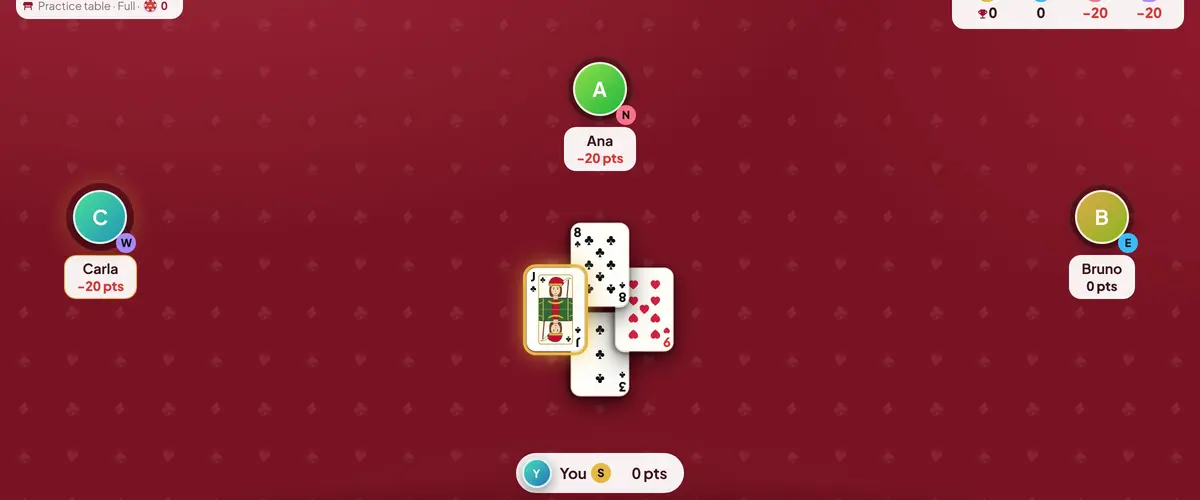 In the Hearts hand, Bruno discards the 9 of hearts and Carla, who wins with the jack of clubs, takes one heart. Screenshot from the King tutorial.
| Hand | Avoid taking | Points | Total |
|---|---|---|---|
| 1. Tricks | Any trick | −20 per trick | −260 |
| 2. Hearts | Heart cards | −20 per heart | −260 |
| 3. Queens | The 4 queens | −50 per queen | −200 |
| 4. Men | Kings and jacks | −30 per card | −240 |
| 5. King of hearts | The king of hearts | −160 | −160 |
| 6. Last two | The 12th and 13th tricks | −90 per trick | −180 |
Special rules of the negative hands
- Hearts and King of hearts: you cannot lead hearts while you hold cards of another suit.
- King of hearts: a player holding the king of hearts who cannot follow suit must discard it on that trick. Nobody can keep it until the end.
- Early end: the Hearts, Queens, Men and King of hearts hands end as soon as all the penalised cards have been played, since there are no more points at stake.
- The Tricks and Last two hands are always played to the 13th trick.
What to think about in each hand
- Tricks: every trick costs 20 points, whatever is in it. Low cards are gold; aces and kings are a problem, and ideally you get rid of them once a suit has run out and you can discard them.
- Hearts: the danger is not winning tricks, it is winning tricks with hearts in them. A trick won in spades with no hearts costs nothing.
- Queens and Men: if you hold a lone queen or king in a suit, try to discard it early, when you cannot follow the suit led.
- King of hearts: whoever has the king wants to discard it; the others want it to land in someone else’s trick. Leading a suit where you are short is the classic way to force the king out.
- Last two: the first 11 tricks do not count. What matters is reaching the end with low cards, so high cards are played early.
The festas
After the negative hands come four festas, the positive hands. In each festa the dealer is the beneficiary: they have the right to choose the contract for the hand. The others can try to buy that right in an auction.
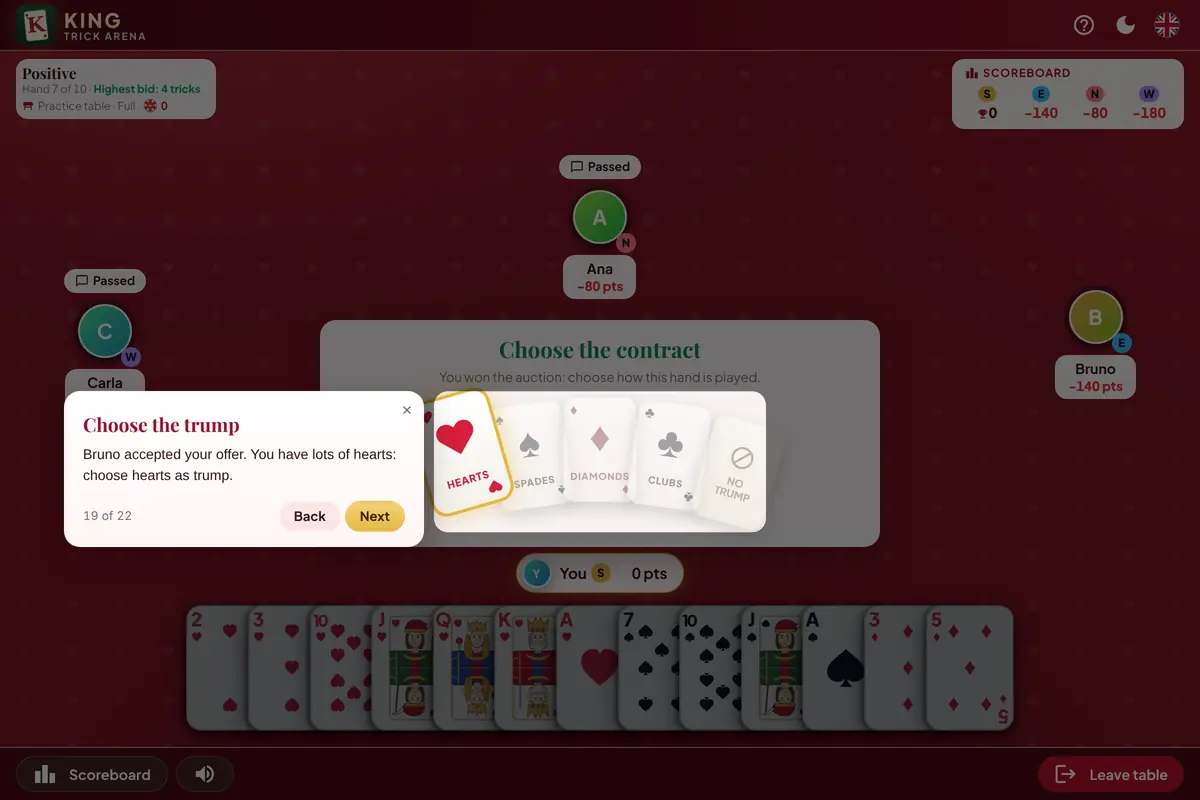 You won the auction and choose how the hand is played: with a trump suit or no trumps. Screenshot from the King tutorial.
| Contract | How it plays | Points |
|---|---|---|
| Trumps | One suit, chosen by the beneficiary, beats the others | +25 per trick |
| No trumps | The suit led always wins | +25 per trick |
| Nulls | Nobody wants tricks | +325, minus 75 per trick |
Obligations in the festas
- With trumps: when trumps are led, you must play above the highest trump already on the table, if you can. If you cannot follow suit, you must trump, and above anyone who has already trumped, if you can. Only a player with neither the suit led nor a trump may discard another card.
- No trumps: a player following suit must play above the highest card of that suit already on the table, if they can. The lower cards of that suit are locked.
- Nulls: there are no trumps and no obligation to play higher, and nobody wants tricks. Each player gets 325 points minus 75 for every trick they take: a player who takes none scores +325, one who takes 6 scores −125.
On TrickArena the game marks the cards you cannot play at each moment, so you do not need to memorise these obligations to get started.
The auction
The auction is the heart of the festas. Starting with the player after the dealer, each player bids tricks or passes. Each bid must be higher than the best bid so far; a player who speaks before the one who made the best bid may match it.
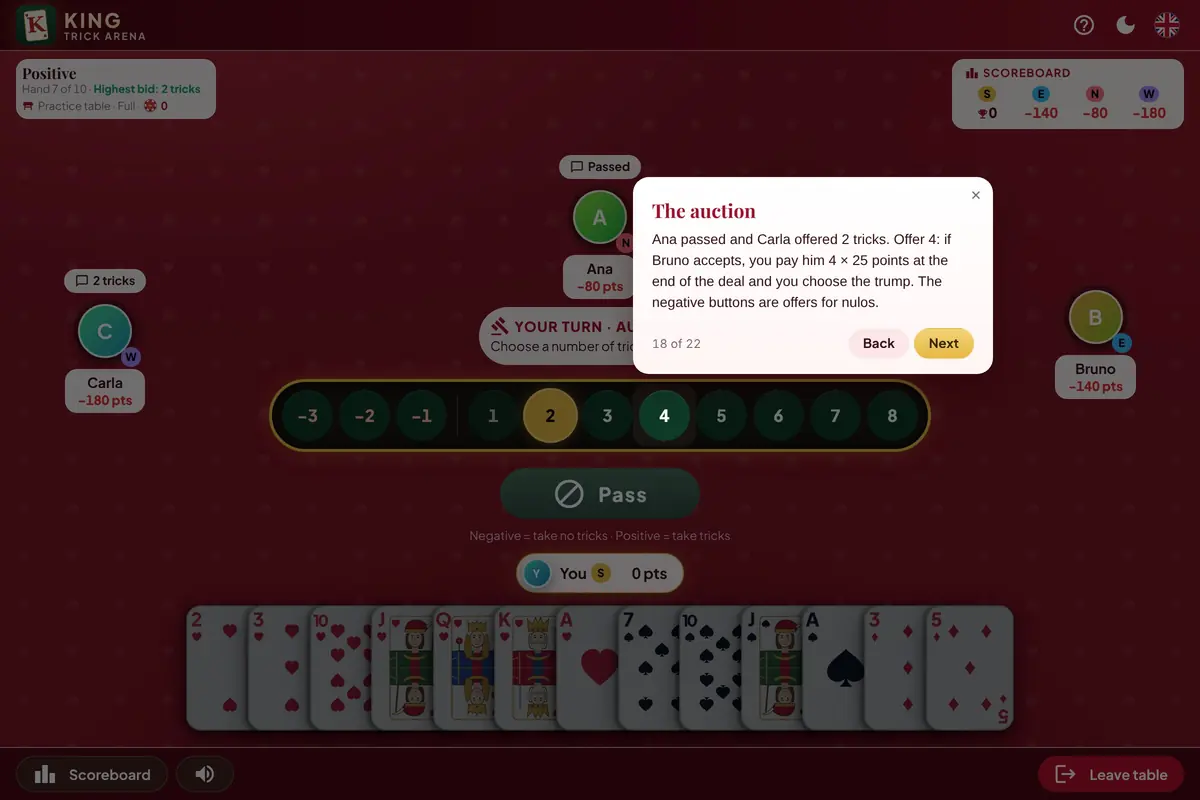 The auction for a festa, where Carla has offered 2 tricks. Screenshot from the King tutorial.
- Bids for positives: 1 to 8 tricks, at 25 points each.
- Bids for nulls: −1, −2 and −3, worth 3, 6 and 8 tricks (75, 150 and 200 points).
When the auction ends, the beneficiary decides. With no bids, they choose the contract at once or take Points. With bids, they have four answers:
| Decision | What happens |
|---|---|
| Accept | The bidder plays the hand and pays the beneficiary the points bid at the end. With a bid for positives they choose trumps or no trumps; with a bid for nulls they play nulls. |
| Reject | The bidder can raise the bid (and the beneficiary decides again) or pass. If they pass, or if the bid was already −3, nobody pays: the beneficiary chooses the contract and plays. |
| 8 or nulls | An ultimatum to the bidder: either pay 8 tricks (200 points) and choose trumps or no trumps, or refuse and the hand is played as nulls, with nobody paying. |
| Points | Nobody plays the hand: the beneficiary gets 100 points and each opponent 75. Only possible with no bids, with a bid of 1 to 3 tricks or with −1 (also after it was rejected). |
A bid of 8 tricks must always be accepted. If the player facing the "8 or nulls" ultimatum lets the time run out, it counts as a refusal and the hand is played as nulls.
An auction step by step
Ana deals and is the beneficiary. Her cards have no strong suit. Bruno, next, bids 2 tricks. Carla, who holds seven spades with the ace and king, bids 4. Diogo passes.
- If Ana accepts, Carla chooses spades as trumps and plays the hand. Every trick scores 25 points for whoever takes it, and at the end Carla pays Ana 100 points (4 × 25). If Carla takes 7 tricks, she scores 175 and keeps 75 after paying.
- If Ana rejects, Carla can raise to 5 or more. If she passes, nobody pays anything and Ana chooses the contract.
- If Ana presses 8 or nulls, Carla must decide: pay 200 points and choose spades, or refuse and play the hand as nulls, where her high spades are a burden.
- Points is not available here, because the best bid is 4 tricks.
The auction is a bet on the other players’ cards. Selling a festa cheaply hands points to an opponent; buying it too dearly can cost more than it earns. The article The King auction explained has more examples.
Game modes
The mode is chosen when the table is created, and it only changes the negative hands:
| Mode | Negative hands | Total |
|---|---|---|
| Full | All 6, one at a time | 10 hands |
| Semi-synthetic | 3: Tricks + Last two, Hearts + King of hearts, Queens + Men | 7 hands |
| Synthetic | 1, with every penalty at once | 5 hands |
In every mode the four festas are played at the end. In Synthetic, a single negative hand takes the same 1300 points as the six hands of the Full mode, so every badly played trick weighs much more.
Time, lives and leaving
- Each move has a time limit, chosen when the table is created. If time runs out, the game plays a valid card for you and you lose a life.
- Each player has 3 lives. A player who runs out of lives or leaves ends the game: they lose their entry, and the others get theirs back.
Chips and ranking
- The entry in chips is paid when all four players confirm. At the end, 90% of the entries are shared among the players with positive points, in proportion to their points; 10% go to the house. If nobody finishes positive, the entries are returned.
- Chips are virtual, cannot be bought and cannot be exchanged for money.
- Ranking: the winner gains 3 points, the other positive players gain 1 and the negative players lose 1. A player who leaves or runs out of lives loses 3.
- There are six levels, starting at 0, 20, 60, 150, 300 and 600 ranking points. Some tables only accept certain levels.
Frequently asked questions
How many points are there in a game? The negative hands always take 1300 points. Each festa played with trumps or no trumps gives 325 points (13 tricks × 25), shared by whoever takes the tricks. The winner is whoever loses least in the negative hands and makes the most of the festas.
Can I play a card of another suit to "escape" a trick? Only if you do not have the suit led. With that suit in your hand you must follow.
Are there trumps in the negative hands? No. In every negative hand the highest card of the suit led wins.
Why did the hand end before the 13th trick? In the Hearts, Queens, Men and King of hearts hands, the hand ends when there are no penalised cards left to play.
What happens if someone leaves mid-game? A player who leaves loses their entry and 3 ranking points, and the game ends for everyone; the others get their entry back.