 Português
 English
 Deutsch
 Español
 Français
 Italiano
Sueca is one of the most played card games in Portugal: in cafés, in clubs, on family holidays. But it did not appear on its own. It belongs to a family of southern European games that share one idea: the ace and the seven are the most valuable cards.
The bisca family
Portuguese bisca, Spanish brisca and Italian briscola use a 40-card deck, a turned-up trump and card points: the ace 11, the three or the seven 10, and the face cards less. Whoever collects more than half of the 120 points wins. Sueca keeps the same count, but it is always played by four, in partnerships, with 10 cards in hand from the start.
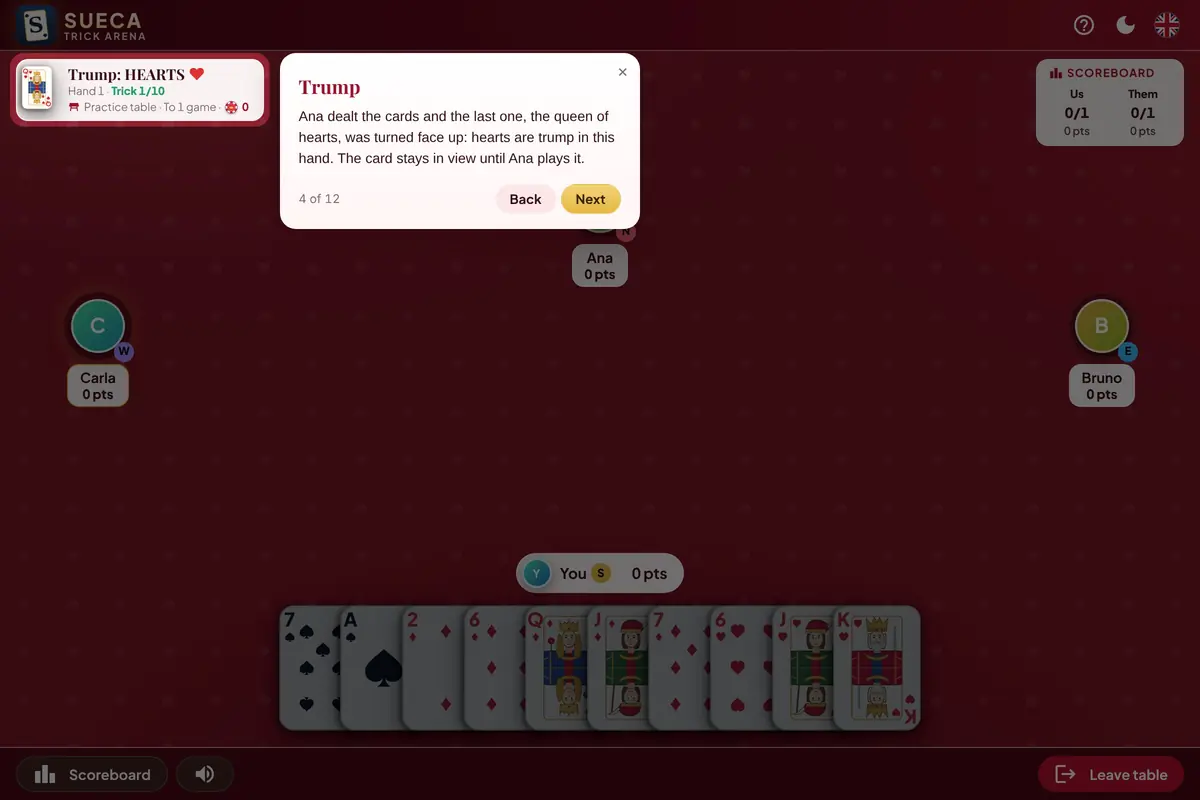 Ana dealt, and the turned-up card, the queen of hearts, makes hearts trumps. Screenshot from the Sueca tutorial.
That is why many players call the seven the "bisca" or the "manilha": it is the second strongest card of each suit.
Why "Sueca"?
Nobody knows for sure where the name comes from. There are several popular explanations, but none is documented. What is known is that the game is mainly Portuguese and that it travelled with the language: it is also played in other Portuguese-speaking countries.
Variants
As with games passed down through generations, some rules change from table to table: who leads first, whether revoking (not following suit when you could) gives games to the opponents, or whether the match is played to four games. At TrickArena the game never lets you revoke, and a match can be played to 1, 3 or 5 games.
Want to try it? Read the beginner’s guide and take a seat at a Sueca table.