 Português
 English
 Deutsch
 Español
 Français
 Italiano
In Vazadas the prediction is everything. You can play your cards perfectly and still lose a life because you said 2 when the hand only gave 1. This article suggests a simple method for predicting, shows why the same card is worth different things at different tables, and ends with five example hands.
The full rules are on the Vazadas page.
What makes Vazadas different
Two rules change everything compared with other trick-taking games:
- You do not have to follow suit. Each card is worth only its rank. An ace beats any king, whatever the suit.
- Some cards are left out. In small hands, most of the deck is not dealt. You do not know whether the other aces are in play.
The order is ace, seven, king, jack, queen, 6, 5, 4, 3, 2, and the ace of hearts always wins. Cards of equal rank tie and cancel the trick.
Step 1: count your sure tricks
A sure trick is one you win whatever happens. Only one card is like that: the ace of hearts. With it in your hand, count one trick.
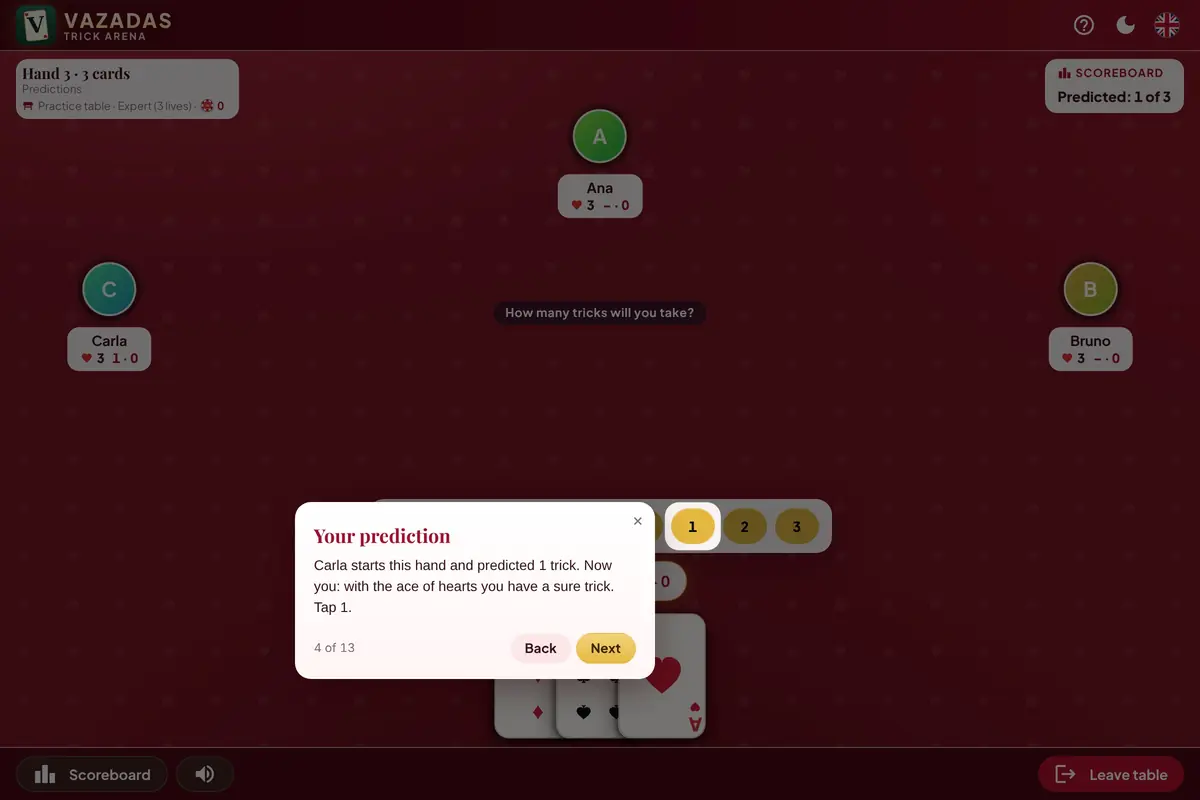 You choose how many tricks you will take in this hand. Screenshot from the Vazadas tutorial.
The other three aces are almost sure: they only lose to the ace of hearts and only tie with another ace. In a small hand, the chance of one of those appearing in the same trick is low; in a large hand, it is much higher.
Step 2: value high cards according to the table
What a seven, a king or a jack is worth depends on how many cards are in play. A rule of thumb:
<div class="data-table"><table><thead><tr><th>Card</th><th>Hands of 1 to 3 cards</th><th>Large hands</th></tr></thead><tbody><tr><td>Ace of hearts</td><td>Sure trick</td><td>Sure trick</td></tr><tr><td>Another ace</td><td>Almost always a trick</td><td>Often a trick</td></tr><tr><td>Seven</td><td>Often a trick</td><td>Half the time</td></tr><tr><td>King</td><td>Sometimes</td><td>Rarely</td></tr><tr><td>Jack or lower</td><td>Rarely</td><td>Almost never</td></tr></tbody></table></div>
Why? In a 2-card hand at a table of 4, only 8 of the 40 cards are in play. There are 4 aces and 4 sevens in the deck, but it is likely that among the others’ 6 cards there is only one ace or seven, or none. Your king has a good chance. In a 10-card hand at a table of 4, every card is in play: all 4 aces and all 4 sevens are there, and your king will almost always meet something higher.
Step 3: count the players
The more players, the more cards per trick, and the harder it is to win with a middling card. A seven at a table of 3 competes with two cards; at a table of 5, with four.
In the one-card hand this is very clear. With a king:
- At a table of 3, only 2 other cards are in play. Saying 1 is reasonable.
- At a table of 5, there are 4 other cards. The chance that at least one is an ace or a seven is high. Say 0.
Step 4: listen to the others’ predictions
Predictions are public and stay on screen. Whoever speaks later has information the first speakers did not have.
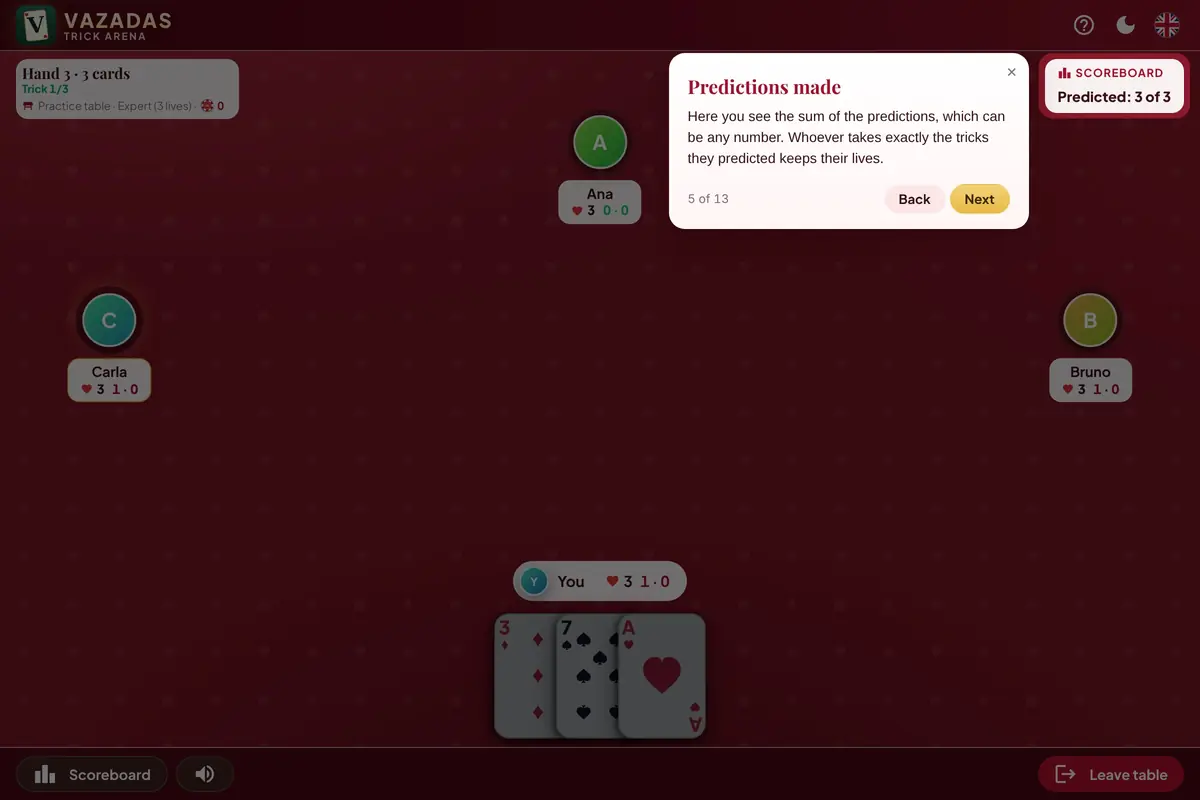 The scoreboard shows the sum of the predictions; anyone who takes exactly the tricks they predicted loses no life. Screenshot from the Vazadas tutorial.
- If the predictions already add up to the number of cards, the table is "full": every trick has an owner. If someone misses, a trick is left over that someone will win without wanting it. Predictions of 0 become riskier.
- If the total is well below, there are "ownerless" tricks. Someone will win them without asking for them, and middling cards are worth more than they seemed.
- If a player predicted 2 in a 2-card hand, they almost certainly hold two very high cards. Your ace may be in danger.
Remember that in Vazadas the last player to speak has no restriction: the total may equal the number of cards.
Step 5: think about the playing order
Whoever leads shows their card and the others respond. Whoever plays last knows what is on the table and can choose to win or let it go.
- If you play late in the trick, you can "control" middling cards: win with a queen when everyone played low, or duck the queen when someone played a king.
- If you are the one leading, you have less control. Predict more conservatively.
Five example hands
Hand 1: one card, table of 5. You hold the seven of clubs. Four other cards are in play, there are four aces in the deck, and three other sevens would tie with you. Prediction: 0. A seven often wins at a table of 3, but at a table of 5 the risk of meeting an ace or a seven is high.
Hand 2: one card, table of 3. You hold the king of spades. Only two other cards are in play. To beat or tie you they must be an ace, a seven or a king: 11 of the remaining 39 cards. The chance that both are lower is close to half. The others have already predicted 0 and 0. Prediction: 1, because if both say they will not win, their cards are probably low.
Hand 3: three cards, table of 4. You hold the ace of hearts, the king of diamonds and the 3 of clubs. The ace of hearts is a sure trick. The king, in a 3-card hand with 12 cards in play, wins sometimes. The 3 does not win. Prediction: 1, and you play the king on a trick where someone has already played high, to lose it.
Hand 4: five cards, table of 4. You hold two aces (neither of them hearts), a jack and two low cards. Before you, the predictions are 2, 1 and 0. The total (3) is already close to the 5 cards. The aces should be worth two tricks, but the player who predicted 2 may hold the ace of hearts and a seven. Prediction: 2. During the hand, whenever you can, play your aces after that player has put their card down: that way you see whether the ace of hearts is in the trick before you commit.
Hand 5: ten cards, table of 4. Every card is in play. You hold the ace of hearts, another ace, two sevens, a king and five low cards. Count: ace of hearts, 1; ace, almost 1; sevens, about half each, so 1 between them; the king almost never, because all 4 aces and all 4 sevens are in play. Prediction: 3. Large hands leave room: if you take an extra trick by accident, you can make up for it by losing on purpose with a middling card later.
Common mistakes
- Predicting by the number of high cards without looking at the table. A king is not worth the same at a table of 3 and at a table of 5.
- Forgetting ties. Two sevens in the same trick cancel each other, and the trick goes to nobody. That can take away a trick you were counting on.
- Predicting 0 with middling cards in a large hand. Once the others have taken their tricks, there are leftover tricks someone has to win, and often it is you, with the queen you wanted to get rid of.
- Letting the time run out. If the prediction time runs out, the game predicts 0 for you. In a hand where you hold the ace of hearts, that is a lost life.
To practise
Start with tables in Beginner mode, with 10 lives: you have room to make mistakes and understand why. Before each prediction, tell yourself which tricks you expect to win and with which card. At the end of the hand, compare. After a few games, the table above becomes second nature.
For more ideas, read the ten Vazadas strategy tips.